PRESS RELEASE
London Art Fair 2026:
England & Co presents British Surrealism
21-25 January 2026
Stand 30, Business Design Centre, Islington
England & Co are pleased to be exhibiting again at the London Art Fair 2026 where the gallery will focus on artworks by British artists directly aligned to the Surrealist movement, alongside other contemporaneous and later British artists who were influenced and inspired by Surrealism.
British Surrealism in its main phase in the 1930s and 1940s was a relatively short-lived movement that emerged directly from the major European Surrealist movement that had developed momentum between the first and second world wars. Surrealism’s arrival in Britain was fostered by two main figures: the British poet, David Gascoyne, who had met many of the French Surrealists through French poet, Paul Eluard and at the Paris atelier of the British artist and printmaker, Stanley William Hayter. The other catalyst was the British artist and writer, Roland Penrose (who will be represented with a substantial selection of his collage works spanning the 1930s to 1970s).
Gascoyne published the ‘First English Surrealist Manifesto’ in the French magazine Cahiers d’Art in 1935. When Gascoyne and Penrose met in Paris in the mid 1930s, they decided to form a British Branch of the Surrealist movement, which led to their being involved in the English committee that organised the first International Surrealist Exhibition that opened at London’s New Burlington Galleries in London in June 1936.
British Surrealism was centred in London, with an active off-shoot in Birmingham whose artists decided not to participate in the 1936 exhibition in London. Surrealism’s influence and its spirit of artistic enquiry lingered in British art long after the original participants dispersed.
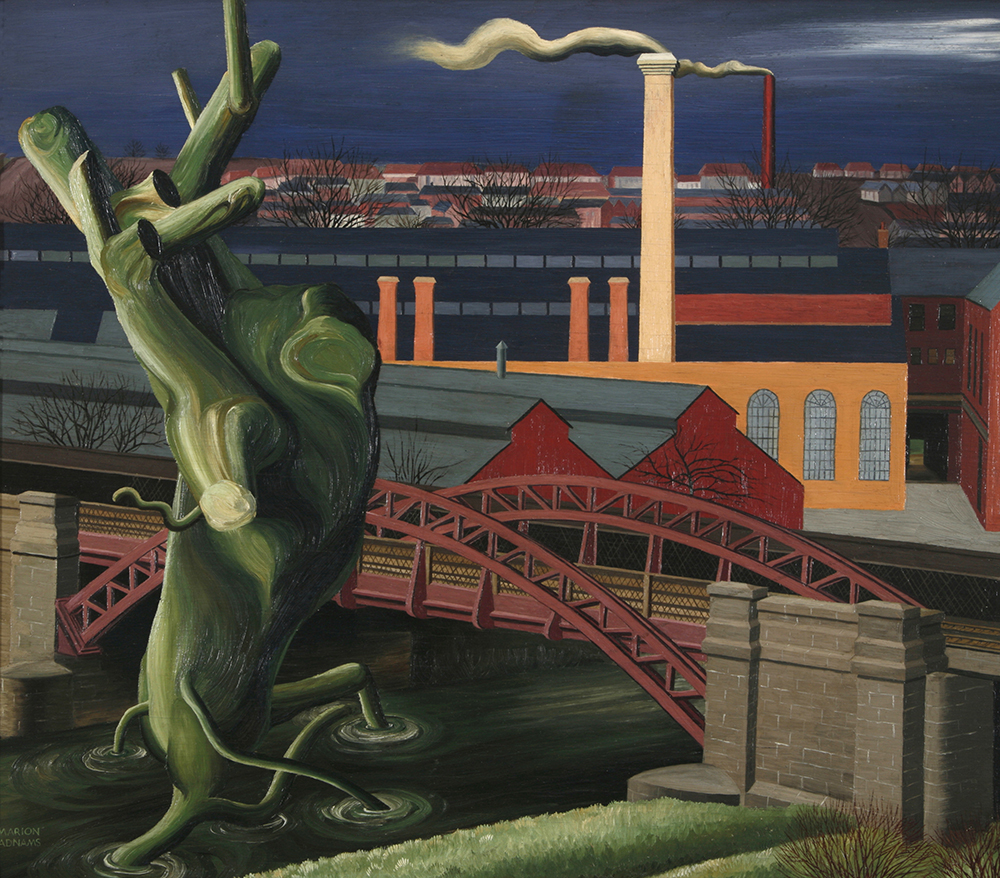
Some of the over 30 artists to be exhibited on our stand will include Marion Adnams, who has increasingly been recognised as an intriguing and independent English Surrealist; John Banting, an early adherent of Surrealist modes, often with a satirical note; Ithell Colquhoun who has recently been the subject of a major exhibition at Tate St Ives and Tate Britain, and who was expelled by the Surrealists for her interests in the occult; John and Ruth Selby-Bigge who met at the Slade and became involved with Surrealism in England and France; John Melville who was a leading figure in the Birmingham Surrealist group; Humphrey Jennings, who was a British filmmaker, poet, and artist involved in arranging the 1936 exhibition; Sir Roland Penrose, an artist who was also a significant collector and promoter of modern art and married the photographer, Lee Miller; and Paule Vézelay who lived for some years with the French Surrealist, André Masson, and has recently been the subject of a touring retrospective in Bristol and at The Towner in Eastbourne.