1892-1973
< BACK
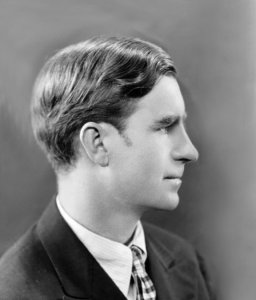
John Amhurst Selby-Bigge was born in Oxford and educated at Winchester and Christ Church, Oxford, before attending the Slade School of Fine Art. There he met fellow artist, Ruth Humphries, and they married in July 1914 just before he left the Slade to serve as a Lieutenant with the Royal Army Service Corps during the First World War.
John Selby-Bigge painted as ‘John Bigge’. In the late 1920s, he became an active member of the Surrealist group of artists through his and his wife’s friendships with Edward Wadsworth, Tristram Hillier and Paul Nash. Wadsworth encouraged his painting and had introduced him to Surrealism and ‘new currents in Paris’. They shared an interest in ‘the aesthetics of machinery, and Selby-Bigge’s visits to London’s Science Museum gave him visual material of ‘fantastic forms, such as sections of ships and pieces of machinery’.
Paul Nash suggested that he should exhibit his paintings and, in April 1931, Selby-Bigge’s first exhibition was held in London at the Wertheim Gallery, paired with a solo exhibition of works by John Banting. This was followed that same year by a solo exhibition at Galerie Vignon in Paris, a successful exhibition with a vernissage attended by Gertrude Stein. In the 1930s, he regularly contributed to mixed exhibitions in London, including Tooth’s Galleries’ annual presentations of Recent Developments in British Painting.
In the early 1930s, Selby-Bigge had various careers, including farming and as an estate agent, before working at his wife’s family’s firm, Lund Humphries, running their London studio and working with the Design Director, Edward McKnight Kauffer and the avant garde photographers Man Ray and Francis Bruguière. He became ‘absorbed in the problems of Abstract art’, studied ‘esoteric philosophy and modern physics’ and in 1933, became a founding member of Unit One at the invitation of Paul Nash. This new group was composed of painters, sculptors and architects, well-known in the modern movement although working independently. The first Exhibition of Unit One was held at the Mayor Gallery, London in April that year, and subsequently toured museums around the UK.
He took part in the first exhibition of Surrealism in England: The International Surrealist Exhibition at the New Burlington Galleries in the summer of 1936. It was his only formal acknowledgement of his involvement in Surrealism.
The Selby-Bigge family moved to Austria in the mid 1930s, but relocated to rural France in 1937, living not far from Gertrude Stein and Alice Toklas. With war imminent, the family left France for Lisbon where Selby-Bigge became involved with his future second wife. Ruth Selby-Bigge returned to England with their daughters in 1941, and their divorce was finalised in 1944.
John Selby-Bigge worked with the British Red Cross in Italy and Austria and was awarded the OBE in 1946. From the late 1940s, he lived in Spain and then in the Dordogne, France. He continued to paint, but was uninterested in exhibiting after the war. He became the second Baronet of King's Sutton on the death of his father in 1951.
His works are held in numerous public collections including Tate, Southampton City Art Gallery, Ferens Art Gallery, Leeds Art Gallery and MIMA, Middlesborough. His work was recently included in Forbidden Territories: 100 Years of Surreal Landscapes at the Hepworth Wakefield in 2024-25.
In December 2025, England & Co held the exhibition, John and Ruth Selby-Bigge: From the Slade to Surrealism, which was the first time their work was exhibited together.
• England & Co represent John Selby-Bigge’s estate and are working on a catalogue raisonné and would be interested to receive any information about the locations of his artworks from the 1920s, 1930s and 1940s, as many are unrecorded.
John Selby-Bigge