
PRESS RELEASE
PARIS PHOTO 2026
12–15 November
Grand Palais, Stand C32
England & Co presents artist-photographers from – or based in – the UK, with works from the 1970s and ’80s through to today. The unifying element for these artists from different generations is their use of photography to document ephemeral performance events or to bring a material presence to conceptual works. They have usually worked across different forms and media, and their photographic works are informed by the wider range of their practices, including installation, collage, video and performance. The ‘self’ and notions around identity have emerged as the main theme of our presentation.
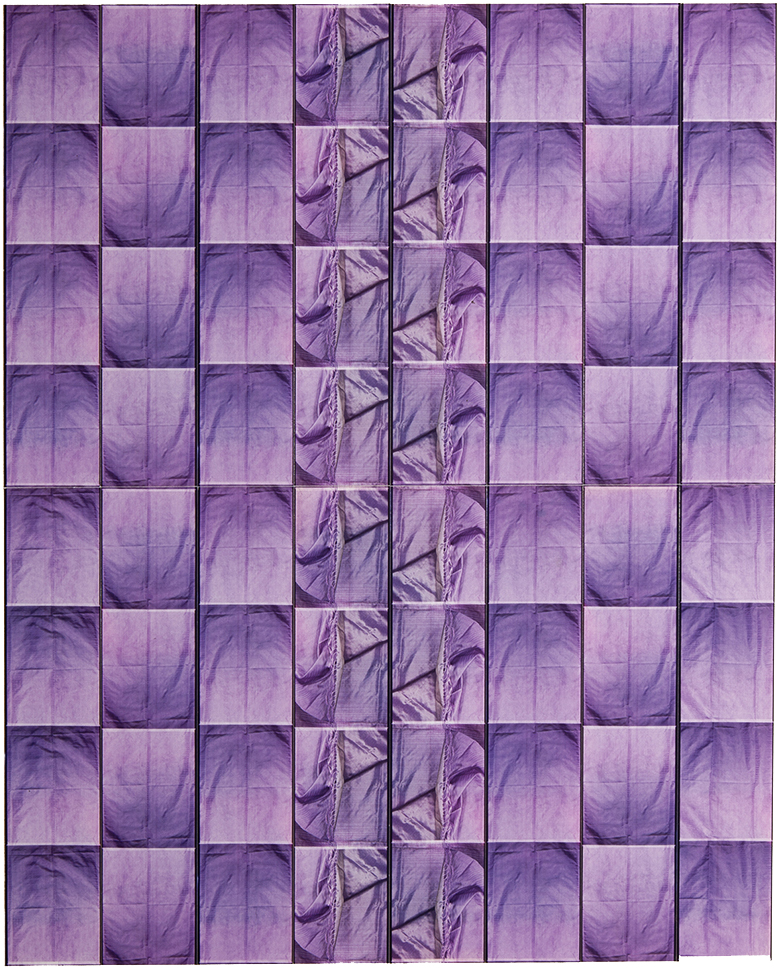
Featured artists this year include Liz Rideal (b. 1954), a British artist and writer known for her pioneering photo-booth photography and photographic works using imagery around self-portraiture, botanical themes, and aesthetics of cloth and drapery. From around 1985, Rideal used improvisatory techniques, together with multiple sequences of four-part photo-booth strips to produce collages ‘in which the miniature images are either subsumed in the overall tissue of a much larger composition or individually enlarged’. A series of her photo-booth works from the 1980s are performative self-portraits of the artist playfully exploring different identities, and other works are from the early 2000s, using plants and objects in pattern-like abstractions, works that also involved her physical presence and dexterity in the photo-booth. This year, Rideal has been selected for the Elles × Paris Photo path dedicated to women artists, in partnership with the French Ministry of Culture.
Works by Croatian-born, London-based artist, Vlatka Horvat (b. 1974) often involve ‘playful alterations of the commonplace that invite the viewer to… imagine alternative possibilities.’ Horvat was the solo artist for the Croatian pavilion at the Venice Biennale in 2024. In her Unhinged series from 2010, Horvat performed with a door that had been removed from its frame to form a ‘door-woman hybrid’ that moved around the grand salons of historical mansions in Lisbon. Unhinged, with its titular gesture to madness, merges body and object into a single unit, ‘collapsing the normative of body and the domestic’.
London-based Venezuelan artist, Lucia Pizzani (b. 1975) is represented by photo-collages from her Acorozada (Armoured) series, works that incorporate self-portraits representing ‘a human who has hybridised with the trees and plants’ into her imagery of woods and green spaces. It is about nature as a refuge and protector, reflecting the artist’s thoughts during the pandemic which was when she began this series of works.
Anne Bean’s (b. 1950) recent Frank series of over-painted photographs arose from her visit to Frank Auerbach’s exhibition, The Charcoal Heads, at London’s Courtauld Gallery in 2025. Bean ‘noticed that people seemed to absorb these portraits. I had a sense of a durational performance in which people seemed to carry the portraits from the wall into their own being. I felt compelled to capture this imbuement.’ Other works displayed reflect Bean’s elemental performance practice.
Polish, London-based artist, Natalia Zagórska-Thomas (b. 1967) presents a sequence of hand-coloured images of herself holding gloved hands over her face, with the gloves ‘blushing’ more as the sequence repeats. This work prefigures a wearable sculpture made when she embroidered the same pair of gloves with ‘blushes’ of pink thread: gloves to blush on behalf of the wearer who does not.
Jemima Stehli (b. 1961) explores the relationship between sculpture, photography and performance in performative experiments where she places herself as either subject or object of the image and often as both, as evidenced in two Floorwork Polaroids from 2004.
British Conceptual artist, James Collins (1939-2021) explored the ‘male gaze’: in works concerning dialogue-as-portrait, the women who appear in his photographs vary, while all male images are self-portraits of Collins. His double portraits of male-female encounters ‘convey a sense of isolation, intimacy, and tension with an erotic charge’ (Art Forum 1977).
Elaine Duigenan’s (b. 1964) artistic investigations are based on historical research with subject matter either ‘found’ or ‘made’, be it a plant or an object. Her Polaroid series, Now We Are Blue explores how orchids are dyed for commercial and aesthetic reasons. In her series, Henry’s Bones, she assembled and documented arrangements of small, weathered fragments of animal bones mud-larked from the banks of the Thames. She liked to imagine that they could be bones discarded from Henry VIII’s favourite palace at Greenwich in the 1500s, and later related these images to another Henry: Henry Moore, after visiting his studio and seeing how he had taken inspiration from bones for many of his sculptures.
The Chinese-born, later British-based artist, Li Yuan-Chia (1929-1994), regarded as China’s first Conceptual artist, produced lyrical, hand-coloured photographs in his last years: still life compositions and gently evasive self-portraits in his garden in Cumbria.
Other exhibited images from the 20th-century include works by Les Krims, Bill Brandt, Aaron Siskind, Man Ray, Sarah Moon, Frank Horvat, Clay Perry, and Rose Boyt.