
PRESS RELEASE
England & Co at PHOTO LONDON 2026
OLYMPIA, LONDON W14 8UX
13–17 May 2026
England & Co are pleased to exhibit again at this year’s Photo London in the new venue at Olympia and look forward to welcoming visitors to our presention on Stand C07. Images from the 1970s and ‘80s related to Performance Art include powerful images by Anne Bean (b. 1950) that emerge from four decades of elemental live performances, including her fragmented Divided Self (1974-82) and from her series Shouting Mortality as I Drown (1974-77). Her recent Frank series of over-painted photographs arose from her visit to the Frank Auerbach exhibition, The Charcoal Heads, at the Courtauld last year. Bean says that she “noticed that people seemed to ‘absorb’ these portraits. I had a sense of a durational performance in which people seemed to ‘carry’ the portraits from the wall into their own being. I felt compelled to capture this imbuement.”
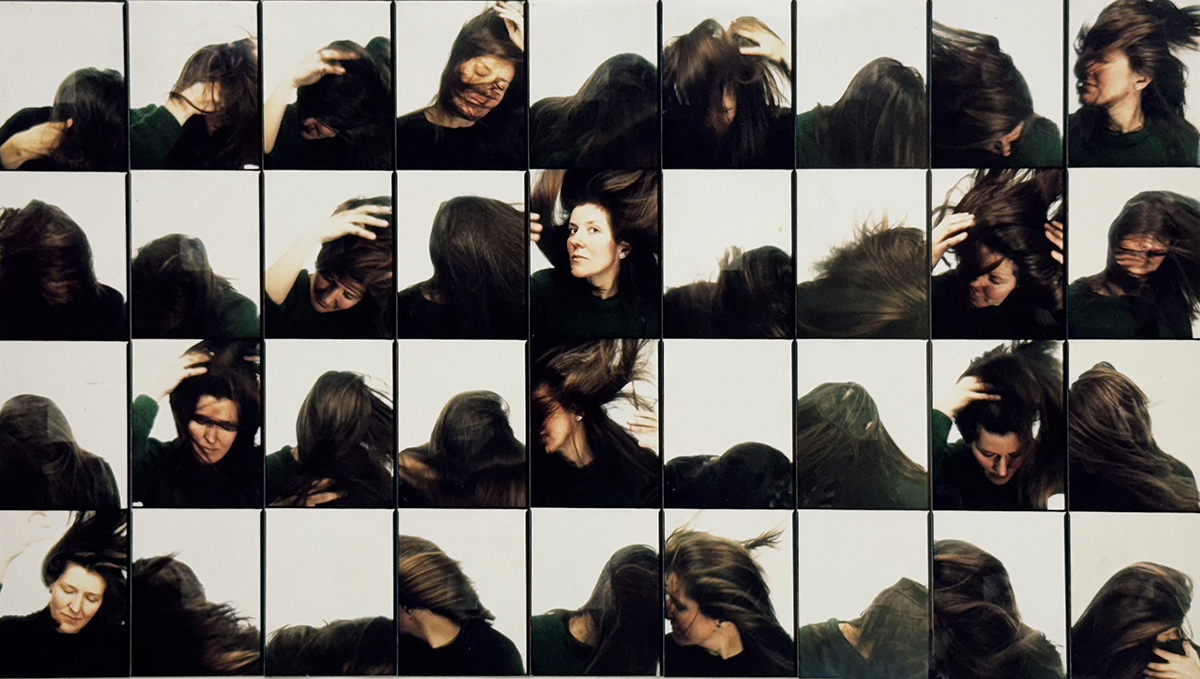
Liz Rideal (b. 1954) is a pioneer of photo-booth photography: from around 1985, she used improvisatory techniques together with multiple sequences of four-part photo-booth strips to produce collages “in which the miniature images are either subsumed in the overall tissue of a much larger composition, or individually enlarged” (A. Moszynska). Exhibited works include the performative Self Portrait, Head Toss (1994) and works from early 2000s, using flowers and plants.
In the late 1970s, David Thorp (b. 1947) worked on performative images concerned with boundaries and constraints, both physical and psychological: these explored limitations of movement (being trapped), concealment, voyeurism, and the avoidance of, or response to, the gaze. In Trapped Trout he examines how systems of looking and representation can fix and contain, rendering both human and animal subjects vulnerable to forms of physical and metaphorical capture.
Elaine Duigenan’s (b. 1964) artistic investigations are based on historical research with subject matter either ‘found’ or ‘made’, be it a plant or an object. Her Wanton Construction series refers to an incident in 1909, when two militant suffragettes broke into greenhouses at Kew Gardens. They removed protective bell jars and destroyed precious orchids leaving a note saying ‘Votes For Women’. The director of Kew Gardens referred to this as ‘wanton destruction’ (the inspiration for this series’ title). Her Polaroid series Now We Are Blue explores ideas around the dyeing of orchids.
British Conceptual artist James Collins (1939-2021) explored the ‘male gaze’; in works concerning dialogue-as-portrait, the women who appear in his photographs vary, while all the male images are self-portraits of Collins. Other double portraits of male-female encounters convey a sense of isolation, intimacy, and tension with an erotic charge (Art Forum 1977).
Works by Vlatka Horvat (b.1974) include some of the photographic collages that emerged from her acclaimed project for the Croatian pavilion at the 60th Venice Biennale (2024), works that began with a photograph taken on her daily walks through Venice. Horvat intervenes with her photographic works using analogue methods including collaging, drawing and cutting. Each intervention emerges directly from something already present in the image: ‘playful alterations of the commonplace that invite the viewer to… imagine alternative possibilities.’
The Chinese-born, later British-based artist, Li Yuan-Chia (1929-1994), regarded as China’s first Conceptual artist, produced lyrical photographs in his last years: still life compositions with his sculptures, flowers and stones in his garden in Cumbria, or of himself performing for his own camera. He evolved these images in a highly personal, spiritual way and his hand-colouring gives them an otherworldly, strangely timeless quality.
Other exhibited 20th-century images include works by Bill Brandt, Man Ray, Sarah Moon, Frank Horvat, Clay Perry, Dafydd Jones, Silvia Ziranek and Rose Boyt.