
PRESS RELEASE
Paul Heber-Percy:
Last House Before the Far-Off
7–24 October 2026
England & Co at 36 Great Pulteney Street, London W1F 9NS
Opening hours: Monday-Saturday 11 – 5.30
Private View: Thursday 8 October 5.30 – 8.00 pm
England & Co are pleased to present paintings and works on paper by Paul Heber-Percy
during the gallery’s October residency at 36 Great Pulteney Street, London W1.
‘The exhibition takes its title from Rilke’s Book of Hours, in which a solitary house stands at the threshold between the known world and the vast unknown beyond it – a village’s last dwelling before the road slips out into the night. It is an image Heber-Percy’s paintings seem to inhabit directly: each work a threshold structure standing at the edge of the visible, looking out toward something larger and unnamed.
‘This new body of work returns to the landscape not as a record of what is seen, but of what is remembered, dreamed, or half-glimpsed at the edge of consciousness. Heber-Percy’s paintings inherit the silence and stillness of Caspar David Friedrich and the visionary charge of nineteenth-century Symbolism, while remaining unmistakably contemporary in their restraint: muted greys, silvered blues, the low burn of a hidden sun.
‘Mist recurs throughout the exhibition as both subject and method. Ridgelines dissolve into cloud; mountains surface at dawn as if remembering their own shape. Elsewhere, mirroring in still water becomes an emblem of doubling, the visible world and its submerged twin held in uneasy equilibrium. Reflection becomes less an optical effect than a suggestion that the visible may be only the surface of something unreachable beneath it.
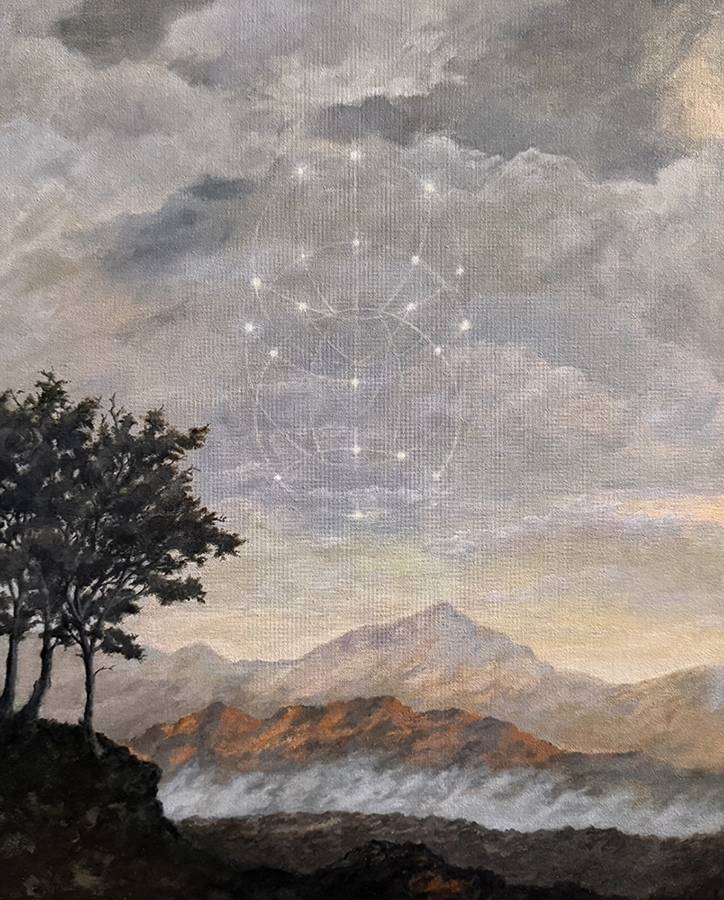
‘A central group of works, which the artist calls the Antiphon, introduces something stranger into the landscape: luminous geometric diagrams hovering over a tree line or darkened valley, like constellations remembered from an old book of alchemy. Invented by the artist, these forms – string-thin lines and pinpoint lights transform the picture plane into a threshold, nature interrupted by pattern, by intention, by mind. They recall Rilke’s conviction that landscape can be read as a kind of script, disclosing a hidden order beneath the visible. The Antiphon diagrams seem to paint that order directly onto the sky: not illustrations of energy, but vibration made visible.
‘Elsewhere, the exhibition turns inward. In The Hermit, a weathered stone statue of a knight emerges from a dark chapel wall, caught between architecture and apparition. In Cave, a black mouth of rock swallows all light, its interior a pure dark that resists the eye. In Asphodel Plain, the exit from a black stone tunnel opens onto a smoke-pale horizon, as though passage itself were the landscape.
‘Most unsettling, and most tender, among the new works is a painting depicting an interior fully intact yet entirely unmoored: staircase, chair and mantel floating whole in a bank of fog, a memory-room severed from any house, drifting through the same mist that dissolves the mountains elsewhere in the exhibition.
‘Taken together, these paintings approach landscape as a psychological instrument rather than a description of place. Heber-Percy’s mountains, caves, interiors and doorways become thresholds between the seen and the sensed, the outer world and the interior one it silently mirrors! ‘ – Simon Moretti, September 2026.
• The exhibition is accompanied by a new publication with a commissioned essay by novelist and writer Chloe Aridjis.